How to Teach Your Child English at Home: A Teacher's 7-Step Plan
Published on August 15, 2026
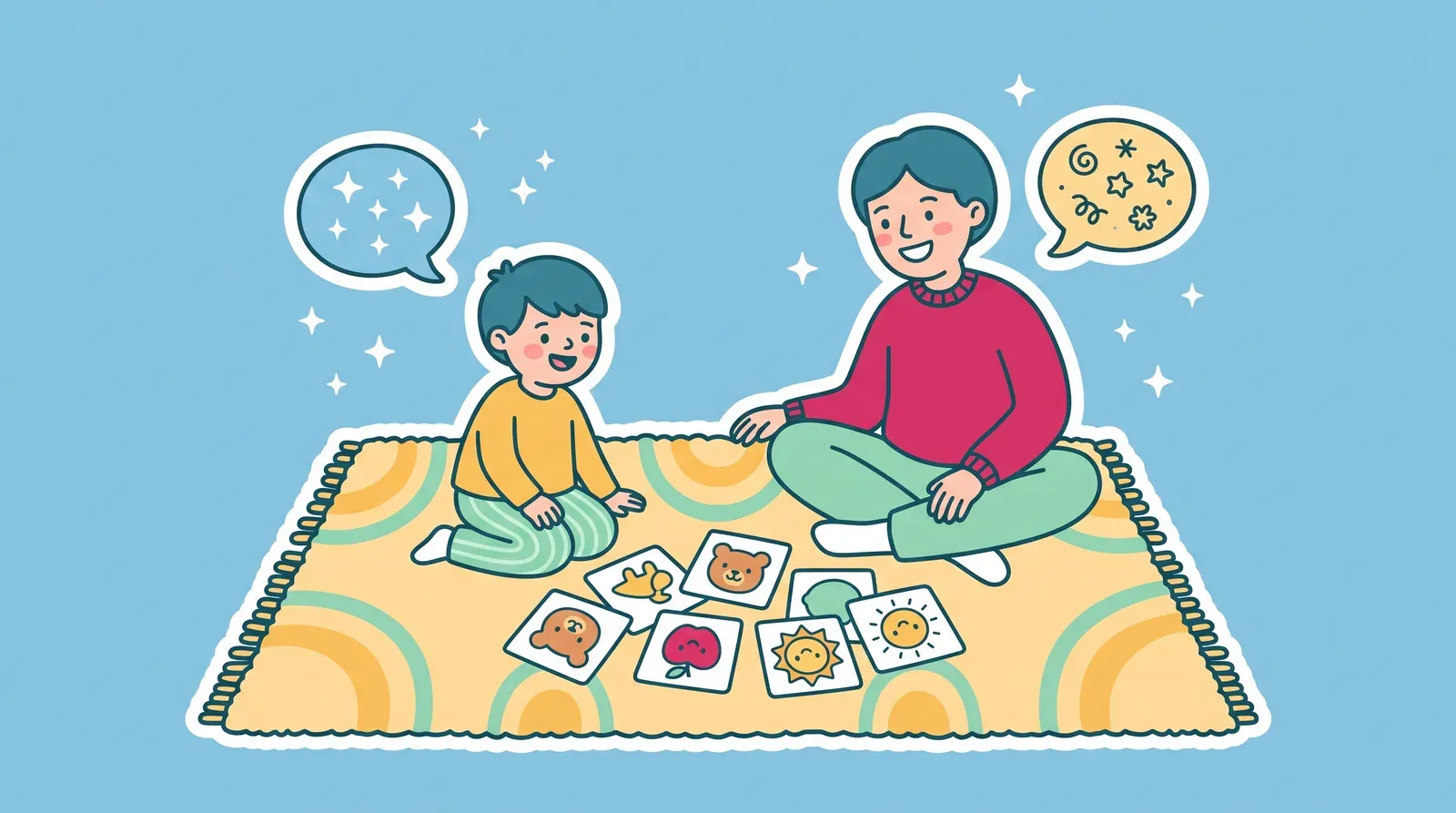
The most effective way to teach your child English at home is a short daily routine — 10 to 15 minutes — built on play and focused on speaking. You do not need to be fluent yourself; what you need are a few habits that make English feel like a game, not a lesson.
The 7 steps below are classroom-tested ideas adapted for home use. Don't try to install them all at once: start with step one and add a new one each week.
1. Ten minutes a day — every day
Language settles through short, regular contact, not long, rare study sessions. Ten minutes every evening beats a single one-hour "English class" on the weekend.
Give the routine a name and a place: after dinner, same corner, "English time!" Children love rituals with names; resistance usually fades within two weeks.
2. Ears and mouth first, writing later
Between ages 6 and 9 the goal is spoken communication. A child who is still mastering writing in their first language shouldn't be wrestling with English spelling — it blocks the most joyful channel, which is talking.
Songs, read-alouds, short dialogues and talking about pictures are the natural tools of this age. School will handle writing; home is where speaking confidence is built.
3. Don't set up lessons — set up games
Drilling word lists at the table looks productive but drains the joy out of the language. In a game, language stops being the goal and becomes the tool: your child speaks to win, to make you laugh, to take their turn — and learning happens on the side.
Card games, guessing games and pretend play are the most productive trio. To start with zero materials, pick two ideas from our list of 8 screen-free speaking games.
4. Don't correct mistakes — model the right form
When your child says "He go school", replying "That's wrong, say it again" chips away at their courage. Instead, echo the correct form naturally: "Yes! He goes to school." They hear the right pattern without feeling corrected.
Teachers call this technique a "recast", and it works just as well at home: keep supplying the correct model and the mistake fades on its own.
5. Ask open questions, not yes/no questions
"Do you like it?" produces a one-word answer. "What do you see?", "What happens next?", "Why is he sad?" produce sentences. The quality of your question decides the length of their answer.
- For describing: What do you see? What colour is it?
- For imagination: What happens next? Where are they going?
- For feelings and reasons: How does she feel? Why?
6. Make storytelling part of the routine
Words stick in stories, not in lists. Making up a story about a picture, summarising the day in three English sentences, or narrating a toy's "day" puts vocabulary into real context.
Storytelling has one more advantage: there is no single right answer. The moment children feel they are not being tested, they start talking. We cover the tools for this in our guide to storytelling cards.
7. Make progress visible
Put new words on the fridge, have a monthly "look what you can say now" chat, celebrate small wins. Children who can see their progress start asking for the routine themselves — visibility is the cheapest fuel for motivation.
"My English isn't great — can I still do this?"
Yes. Cards with the questions printed on them and games with step-by-step guides are designed to carry the language for you: you run the game, the cards do the English. And learning together sends your child the most valuable message of all — mistakes are normal, and learning is fun.
Where Talkie Box fits in
Talkie Box is this article in a box: 68 story cards in 12 themed sets, easy and hard question cards for every set, and a parent & teacher guide. Because the questions are printed on the cards, you can run "English time" from day one even with limited English.
Take a closer look on the product page, or try the game loop in the 2-minute online demo.
To start today, do just one thing: pick a picture and ask — "What do you see?"

Bilge Karslı
English teacher, creator of Talkie Box