Storytelling Cards for Kids: What They Are and How to Use Them
Published on August 15, 2026
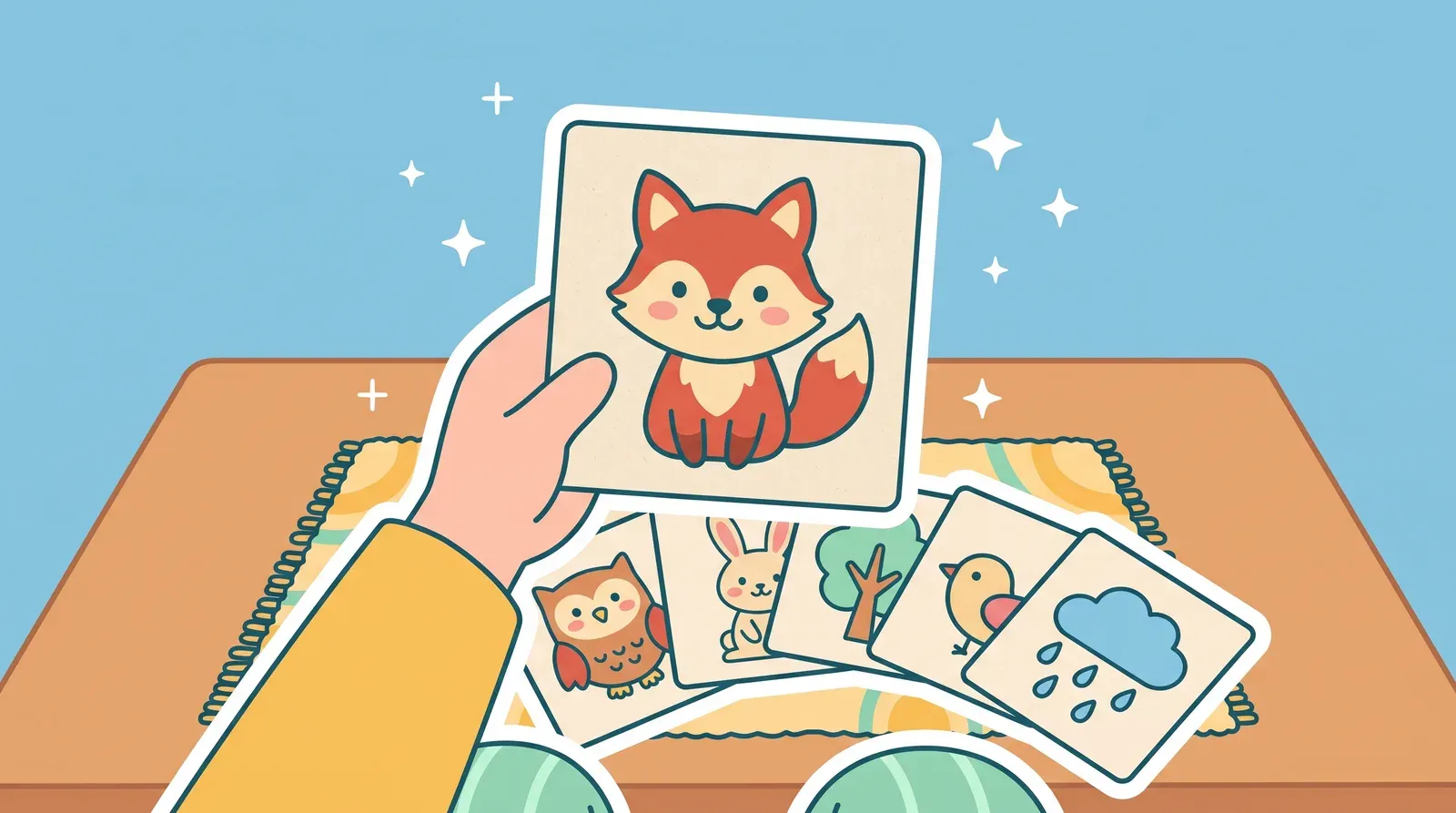
Storytelling cards are speaking tools: picture cards that get a child building a narrative in their own sentences. They work because a picture offers a safe starting point with no single right answer — the child speaks from what they see and imagine, not from memorisation.
What exactly is a storytelling card?
A storytelling card shows a single illustrated scene, usually accompanied by questions ("What do you see?", "What happens next?"). In English teaching they're also called picture prompts. A card doesn't look like study material — it looks like a game piece, and that is exactly where its power comes from.
Why do they get kids talking?
- Concrete support: the picture carries the "what do I say?" load, so the child spends their energy on "how do I say it?".
- Open-endedness: one card holds a hundred stories; with no wrong answers, courage grows.
- Replay value: the same card produces a completely different story a week later — the material never wears out.
- Vocabulary in context: new words are learned inside the child's own story, not on a list.
Three ways to use them at home
- Card of the day: one card, three sentences, every evening. Keeping it short protects the routine — it stretches naturally on good days.
- Shared story: put the card between you and add one sentence each in turns. Your sentences quietly become the correct model.
- Describe and guess: the child describes the card without showing it; you guess the picture. Description practice at its most fun.
Three ways to use them in class
- Warm-up opener: start the lesson with a single card; two volunteers give one sentence each, and the class opens with speaking.
- Pair talk and swap: one card per pair; after two minutes the cards rotate. Everyone speaks at the same time — not one by one.
- Station activity: card sets spread across tables; groups rotate and build a new story at every station.
What makes a good storytelling card?
- One clear scene (a crowded composition tires young learners)
- At least one detail open to interpretation (something that makes them ask "why?")
- An age-appropriate theme from the child's own world
- Companion questions that scale with level
- Print quality that survives small hands
The Talkie Box approach
Talkie Box holds 68 story cards in 12 themed sets, with easy and hard question cards in every set. The game loop has four steps: pick a card, answer its questions, build your story, share it out loud. Easy cards can be answered straight from the picture; hard cards reach into imagination and reasons — so the same deck plays at two levels.
See the four steps illustrated on the how-to-play page, or look inside the box on the product page.

Bilge Karslı
English teacher, creator of Talkie Box