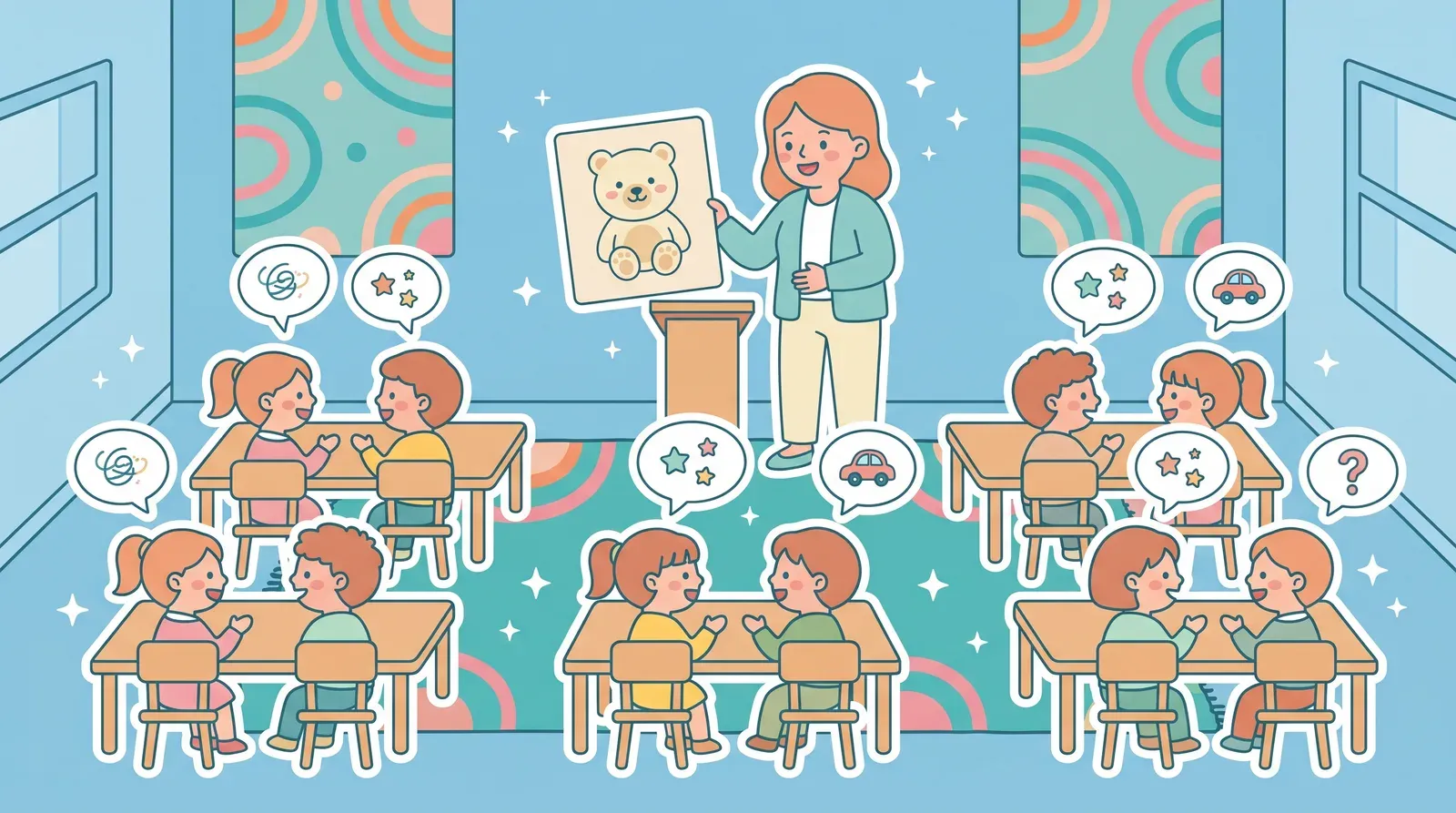
For a speaking activity to work in an ESL classroom, three conditions must hold: preparation stays low, students speak simultaneously (in pairs or small groups, not one by one), and something concrete carries the talk — a picture, a card or a sentence frame. The ten activities below were chosen on exactly those terms.
1. Think-Pair-Share
Give the question, allow 30 seconds of thinking time, pairs tell each other, a few volunteers share with the class. The thinking time is what lets weaker students arrive with a sentence ready.
2. Picture-talk pairs
One picture or story card per pair: one describes, the other must ask a question. Roles swap after two minutes.
3. Story circle
The group builds a story one sentence at a time. Seed it with a card or three key words; keep circles small (4-5 students) so every child speaks often.
4. Hot seat
One student sits with their back to the board; the class explains the word on it using English clues. The whole class does the talking — the winner is whoever explains, not whoever knows.
5. Role cards
Shop, lost-property office, restaurant: write three sentence frames on each role card. The frames are a safety net; once the scenario settles, the cards go back in the pocket.
6. "Find Someone Who" class walk
A five-item list like "Find someone who likes cats"; students walk the room asking questions ("Do you like cats?") and collecting names. The entire class speaks at once.
7. Two pictures, spot the difference
Give pairs two versions of the same scene with small differences; without showing their pictures, they find the differences by talking ("Is there a cat in your picture?").
8. Show-and-tell rota
Once a week, three students present an object from home in three sentences and take two questions from the class. Over a term, everyone gets their moment on stage.
9. Class survey
Each student tours five classmates with a one-question survey ("Do you like pizza?") and marks results on a board chart. The question pattern repeats until it's automatic — but inside a game.
10. Story-card tournament
Give each group a set of story cards; every group picks its best story and performs it. Vote in categories — funniest, most exciting, most creative — so there's more than one winner.
Managing speaking activities
- Sentence-frame wall: keep starters like "I can see...", "I think...", "What about you?" on the wall; a stuck student borrows from the wall.
- Model first: play the activity with one student in front of the class for 30 seconds before starting.
- Delay correction: take notes during the flow and address common errors afterwards, without names. Corrections that interrupt the flow also interrupt the appetite to speak.
- Keep time visible: a sand timer or countdown; short rounds beat long ones.
- Randomise turns: name sticks or a draw, so the floor doesn't always go to the same three hands.
Using Talkie Box in the classroom
Talkie Box's 12 themed sets spread naturally across stations, and the easy and hard question cards in every set let you differentiate inside a single activity — a beginner pair works with easy cards while a stronger pair takes the hard ones. The parent & teacher guide describes the game flow.
For classroom scenarios and resources, see the For Teachers page; and for deeper work with story cards, here's our full guide.

Bilge Karslı
English teacher, creator of Talkie Box